
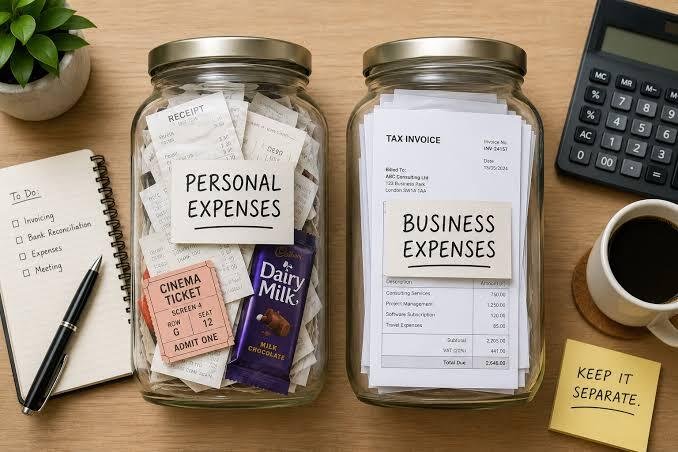
Running a business as a sole trader means there is no legal separation between you and the business in the same way there is with a limited company. You are personally responsible for the business, and your profits are normally reported through Self Assessment. That does not mean business and personal spending should be mixed.
Keeping business and personal expenses separate is one of the most effective ways to maintain accurate records, calculate taxable profit correctly and reduce the time required to prepare your Self Assessment tax return. It also makes it easier to identify allowable expenses, investigate unusual transactions and provide evidence if HMRC asks questions about your records.
A sole trader can use a personal or business bank account for business transactions, but HMRC requires self-employed people to keep accurate records and be able to identify business transactions. HMRC’s guidance also requires records of business income, business expenses and personal income to be maintained.
AccountancyNet Ltd is a UK-based accountancy practice based in Manchester and serving businesses across England and Wales. Its services include bookkeeping, Self Assessment, accounts preparation, payroll, VAT filing and Making Tax Digital compliance. For sole traders who want help maintaining accurate financial records, AccountancyNet’s bookkeeping service provides support with organising business transactions and financial data.
Why Should Sole Traders Separate Business and Personal Expenses?
Separating business and personal expenses is not simply an accounting preference. It creates a clearer financial record of your trading activity and makes it easier to determine which costs relate to the business.
When business and personal payments are mixed, every transaction has to be reviewed and classified. A £2,000 bank statement could contain:
- Customer payments
- Supplier invoices
- Business subscriptions
- Personal shopping
- Mortgage payments
- Utility bills
- Business travel
- Personal travel
- Cash withdrawals
- Transfers to personal savings
If these transactions are mixed together, bookkeeping becomes more complicated.
A separate business account gives you a much clearer starting point. Money received from customers can be identified as business income, while payments to suppliers and service providers can be reviewed as potential business expenses.
Personal withdrawals can also be identified without being confused with business costs.
The objective is not to create a separate legal entity. A sole trader remains personally responsible for the business. The objective is to create a reliable accounting trail.
What Does HMRC Require From Sole Traders?
Sole traders must keep records of business income and expenses for their Self Assessment tax return. HMRC states that records should be accurate and that you must be able to identify business transactions. You also need to keep records of personal income.
The records should allow you to calculate your business profit or loss and support the figures included in your tax return.
Examples of records include:
- Sales invoices
- Purchase invoices
- Receipts
- Bank statements
- Credit card statements
- Payment records
- Mileage records
- Business expense records
- VAT records where applicable
- Payroll records where applicable
- Records of money taken from the business for personal use
Separating expenses helps satisfy the practical requirement that business transactions can be identified.
It also creates a stronger audit trail if HMRC asks how you arrived at a particular figure.
Open a Separate Bank Account for Business Transactions
The simplest way to separate finances is to use a dedicated bank account for the business.
The account does not need to be a limited-company account because you are a sole trader. The important point is that it is used primarily for business transactions.
Before opening an account, check the bank’s terms because different banks have different rules about using personal and business accounts for trading activity. HMRC specifically notes that a self-employed person may be able to use a personal or business bank account for business transactions, but the bank’s conditions should be checked.
A separate account can receive:
- Customer payments
- Online marketplace payments
- Business refunds
- Business loans
- Other trading income
It can pay: - Supplier invoices
- Software subscriptions
- Advertising
- Business insurance
- Professional fees
- Business travel
- Business equipment
- Other allowable business costs
This gives you a cleaner transaction history.
Do Not Use the Business Account for Personal Shopping
Once a separate business account is established, avoid using it for personal spending.
Do not routinely pay for:
- Groceries
- Personal clothing
- Family holidays
- Personal entertainment
- Household shopping
- Personal subscriptions
- Private loan repayments
- Personal investments
If you need money from the business for personal use, transfer an appropriate amount from the business account to your personal account.
Record the transfer as money taken for personal use rather than as a business expense.
For example:
Business account: £3,000
Transfer to personal account: £1,000
Business expense: £0
The £1,000 is not a business cost simply because it came from the business account.
HMRC specifically states that money taken from a self-employed business for personal use is not an allowable business expense.
Create a Personal Account for Personal Spending
The separation works both ways.
Do not routinely pay business suppliers from your personal account if you can avoid it.
A clean structure is:
Business account → business income and business costs
Personal account → household and personal spending
When the business makes money, transfer funds to your personal account as needed.
This makes it much easier to see:
- Business turnover
- Business expenses
- Personal withdrawals
- Available business cash
- Actual operating costs
The separation also helps when an accountant reviews the accounts.
What If You Pay a Business Expense Personally?
There will be occasions when you use your personal debit or credit card to pay for something the business needs.
For example, you may purchase a £150 software subscription using your personal card because the business card is not available.
The expense does not automatically become personal simply because you used a personal payment method.
The important issue is the nature of the expense and whether it qualifies under the tax rules.
Record the transaction as a business expense and retain the receipt.
Depending on your bookkeeping system, the payment can be recorded as a business expense with a corresponding amount owed to you or treated appropriately as money introduced into the business.
The exact accounting treatment should be consistent with your accounting method and bookkeeping records.
Keep Receipts for Business Purchases
A bank statement shows that money left your account. It may not explain what you purchased or why.
For example, a statement might show:
CARD PAYMENT – £420
That does not establish whether the payment was for:
- Business equipment
- Personal shopping
- Software
- Travel
- Training
- Entertainment
- Something else
A receipt or invoice provides the missing information.
Keep receipts and invoices for: - Equipment
- Office supplies
- Software
- Advertising
- Professional fees
- Insurance
- Travel
- Business materials
- Repairs
- Stock
- Subcontractor costs
HMRC states that proof can include receipts, bank statements, sales invoices, till rolls and bank slips.
Use Accounting Software to Categorise Transactions
Accounting software can make separation easier by connecting your business bank account to your bookkeeping records.
Each transaction can be categorised as:
- Sales
- Office costs
- Travel
- Advertising
- Professional fees
- Insurance
- Bank charges
- Equipment
- Materials
- Subcontractors
- Personal drawings
- Other relevant categories
The important point is that software does not replace judgement.
A transaction should not be marked as a business expense simply because the software suggests an expense category.
You remain responsible for determining whether the cost relates to the business and whether it is allowable.
Reconcile the Business Bank Account Every Month
Bank reconciliation should be a regular process rather than a year-end task.
At the end of each month:
- Download or connect the business bank transactions.
- Match customer payments to sales.
- Match supplier payments to invoices.
- Categorise business expenses.
- Identify personal transactions.
- Record transfers to your personal account.
- Investigate unknown payments.
- Check the closing balance against the bank statement.
- Attach receipts or invoices where appropriate.
- Correct errors before moving into the next month.
Monthly reconciliation prevents small errors from accumulating.
A £30 transaction may seem insignificant, but hundreds of unidentified transactions create a significant bookkeeping problem.
Set Up Clear Expense Categories
Use a consistent category structure.
A sole trader might use categories such as:
Sales and income
- Customer invoices
- Online sales
- Platform payments
- Other trading income
Office costs
- Stationery
- Printing
- Postage
- Software
- Telephone
- Internet
Premises
- Rent
- Business rates
- Utilities
- Repairs
- Cleaning
Travel
- Public transport
- Business mileage
- Parking
- Hotels
- Qualifying business meals
Professional costs
- Accountancy
- Legal fees
- Professional subscriptions
- Business consultancy
Marketing
- Website
- Advertising
- Social media
- Printing
- Promotional materials
Financial costs
- Bank charges
- Business loan interest
- Payment processing fees
Equipment
- Computers
- Tools
- Machinery
- Office equipment
Personal
- Personal withdrawals
- Personal purchases
- Private transfers
Consistent categories make year-end reporting more efficient.
Create a Personal Withdrawal Category
One of the most important categories for a sole trader is personal drawings or personal withdrawals.
Suppose your business account receives £5,000 during the month.
You spend:
- £1,500 on suppliers
- £300 on advertising
- £200 on software
- £500 on business travel
- £1,000 transferred to your personal account
The £1,000 transfer is not an expense.
The business expenses total £2,500.
The £1,000 is money taken from the business for personal use.
Keeping these transactions separate prevents the taxable profit calculation from being reduced incorrectly.
Understand the Difference Between a Business Expense and a Personal Expense
The fact that a payment benefits you while operating the business does not automatically make it a business expense.
A genuine business expense normally needs to relate to the trade.
Examples of common business costs include:
- Business software
- Office supplies
- Advertising
- Business insurance
- Professional fees
- Business travel
- Stock
- Materials
- Qualifying equipment
HMRC allows deductions for qualifying business expenses when calculating taxable profit, but private spending is not an allowable business expense.
This distinction should be applied to every transaction.
Deal With Mixed Business and Personal Expenses Correctly
Some expenses have both business and personal use.
These require a reasonable method of separating the business element from the private element.
For example, assume your annual mobile phone bill is £600.
You determine that:
- Business use = 70%
- Personal use = 30%
The business element would be £420.
The personal element would be £180.
You should not automatically claim the entire £600.
HMRC’s guidance gives the same principle for mixed-use costs: only the business element can be claimed.
This can apply to: - Mobile phones
- Internet
- Vehicles
- Home working
- Household utilities
- Other assets or services with mixed use
Keep the calculation supporting your business percentage.
Keep a Written Basis for Apportionment
If an expense has mixed use, record how you calculated the business proportion.
For example:
Mobile phone
Annual cost: £720
Business use: 75%
Allowable business amount: £540
Private amount: £180
A simple note explaining the calculation can be useful.
For home working, you might calculate the proportion using the rooms used for business and the amount of time spent working there.
HMRC’s guidance gives examples of reasonable methods for dividing household costs between business and private use.
The calculation should be reasonable and consistent.
Do not choose a percentage simply because it produces the largest tax deduction.
Keep Home and Business Costs Separate Where Possible
Working from home creates more opportunities for mixed expenses.
Household costs may include:
- Electricity
- Gas
- Water
- Council Tax
- Rent
- Mortgage interest
- Internet
- Telephone
Some of these costs may have a business element where the relevant conditions are met.
Instead of treating the entire household bill as a business expense, calculate the appropriate business proportion.
For eligible sole traders, simplified expenses can also be used for working from home. The simplified method uses flat rates based on qualifying hours worked at home.
The important point is to choose a method and maintain the records required to support it.
Keep Business Travel Separate From Personal Travel
Travel is another area where business and personal costs can easily become mixed.
A business journey might include:
- Travelling to a client
- Visiting a temporary workplace
- Attending a qualifying business event
- Travelling to collect business supplies
- Travelling between business locations
Personal travel might include: - Holidays
- Family trips
- Private appointments
- Social journeys
If a journey combines business and personal activities, carefully identify the business element.
Keep: - Date
- Starting point
- Destination
- Business purpose
- Mileage
- Parking receipts
- Tickets
- Hotel invoices
A mileage log is particularly important if you use your own vehicle for business journeys.
Keep a Separate Business Credit Card
A business credit card can be useful if your business has regular expenses.
It can provide:
- A dedicated spending record
- Easier expense tracking
- A central place for business purchases
- Easier reconciliation
- Less risk of mixing personal transactions
The card should be used only for business spending.
If you use it for a personal purchase, identify the transaction immediately and record it as personal rather than allowing it to remain classified as a business expense.
Avoid Cash Where Possible
Cash transactions are harder to track than electronic payments.
If you accept cash from customers, record each sale and deposit the money into the business account.
If you withdraw cash for business purposes, record:
- Date
- Amount
- Purpose
- Receipt
- Business category
If you withdraw £200 and spend only £120 on business costs, the remaining £80 should not automatically be treated as a business expense.
Maintain a record showing what happened to the money.
Record Transfers Between Accounts Correctly
Transfers between your own accounts can be confusing.
Suppose you transfer £2,000 from your business account to your personal account.
That is not business expenditure.
It is a personal withdrawal.
If you transfer £500 from your personal account into the business account, that is not business income.
It is money introduced into the business.
Correctly recording these movements prevents your turnover and expenses from being overstated.
Do Not Treat Loan Drawdowns as Business Income
If you take out a business loan, the amount borrowed is not normally trading income.
It creates a financing transaction.
For example:
Business loan received: £10,000
This does not mean:
Business turnover: £10,000
The accounting treatment of loan principal and interest is different.
Business loan interest may qualify as a business cost under the relevant rules, while repayment of the principal is not simply an ordinary trading expense.
Keep loan agreements and statements so the transactions can be classified correctly.
Keep Business Assets Separate From Personal Assets
Sole traders can own assets personally, but the accounting treatment of assets used for the business needs to be considered carefully.
Examples include:
- Laptop
- Camera
- Tools
- Machinery
- Vehicle
- Office furniture
If an asset is used partly for business and partly privately, the private use may affect the amount that can be claimed.
Do not claim the entire cost simply because the asset is useful to your business.
Record: - Purchase date
- Purchase price
- Supplier
- Business purpose
- Business-use percentage where relevant
- Private-use percentage where relevant
- Payment method
For significant assets, check whether the expenditure should be treated under capital allowances or the applicable cash-basis rules.
Understand Cash Basis Accounting
Cash basis accounting is currently the default accounting method for many sole traders from the 2024/25 tax year, unless they opt out or cannot use it. Under cash basis accounting, income and expenses are generally recorded when money is received or paid.
This makes bank records particularly important.
For example, if you pay a supplier on 30 March, the payment is recorded based on the cash-basis rules for the relevant period.
If you receive customer money in April, it is recorded when received.
Your bookkeeping system should be configured consistently with your chosen accounting basis.
Keep Records for the Full Tax Year
The UK tax year runs from 6 April to 5 April.
Your records should cover the full relevant period.
Do not wait until the Self Assessment deadline to start sorting transactions.
A better process is:
Daily: Keep receipts and invoices.
Weekly: Upload documents and record unusual transactions.
Monthly: Reconcile the bank and review categories.
Quarterly: Review profit, expenses and tax position.
Year-end: Finalise records and prepare the tax return.
This approach reduces the risk of missing expenses or misclassifying personal transactions.
Separate VAT From Personal Spending
If you are VAT registered, keeping business transactions separate becomes even more important.
VAT records need to be maintained accurately, and business purchases may contain input VAT that can potentially be reclaimed subject to the applicable rules.
A mixed personal and business transaction can make VAT treatment more complicated.
For example, if a purchase is partly personal and partly business, you need to consider both:
- Income Tax treatment
- VAT treatment
The two systems are related but not identical.
Keep VAT invoices and supporting documentation for relevant purchases.
AccountancyNet Ltd provides VAT support and filing services for businesses. Its VAT services can be useful for businesses that need assistance with VAT returns and bookkeeping.
Prepare for Making Tax Digital
Digital record-keeping is becoming increasingly important for sole traders.
HMRC’s Making Tax Digital for Income Tax rules require digital records for affected self-employed businesses, with digital records covering income and expenses. HMRC’s current guidance explains that records should include amounts, dates and categories and that supporting documents such as invoices and bank statements should continue to be retained.
Keeping business and personal transactions separate makes digital bookkeeping easier.
A dedicated business bank account can feed business transactions into accounting software without requiring every personal transaction to be reviewed.
This reduces manual work and improves categorisation.
For sole traders approaching Making Tax Digital requirements, maintaining clean records early is more effective than trying to reconstruct several months of transactions later.
Use Digital Receipt Storage
Paper receipts can be lost.
Digital receipt storage provides a searchable record of business purchases.
For every business expense, aim to retain:
- Supplier name
- Date
- Amount
- Description
- VAT information where relevant
- Payment method
- Business purpose
Accounting software or receipt-capture tools can help store this information alongside the transaction.
A digital bank feed combined with digital receipts creates a useful audit trail.
Create a Monthly Expense Review
Set aside time once a month to review your expenses.
Use the following checklist:
Bank account
- Are all transactions categorised?
- Are there unknown payments?
- Are customer receipts matched?
- Are supplier payments recorded?
- Are personal transfers identified?
Receipts
- Are receipts attached?
- Are invoices available?
- Are missing documents followed up?
Mixed expenses
- Are business/private percentages documented?
- Are personal elements excluded?
Travel
- Are business journeys recorded?
- Is mileage up to date?
- Are personal journeys excluded?
Equipment
- Are asset purchases identified?
- Do capital treatment rules apply?
VAT
- Are VAT invoices retained?
- Are personal elements excluded?
Personal spending
- Have private transactions been classified as personal?
This review can take less time each month than correcting a year’s worth of transactions.
Create Rules for Your Business
Simple internal rules can prevent inconsistent treatment.
For example:
Rule 1: Business purchases are paid from the business account.
Rule 2: Personal purchases are paid from the personal account.
Rule 3: Business expenses paid personally are recorded immediately.
Rule 4: Every business expense has supporting evidence.
Rule 5: Mixed-use costs are apportioned.
Rule 6: Personal withdrawals are never categorised as expenses.
Rule 7: Bank accounts are reconciled monthly.
Rule 8: Large purchases are reviewed before being classified.
These rules are particularly useful when a sole trader starts hiring staff or delegates bookkeeping.
Keep Business and Personal Email Records Organised
Financial separation is not limited to bank accounts.
Store business invoices and receipts in a dedicated business folder.
For example:
Business Finance
- Sales
- Purchases
- Bank
- VAT
- Travel
- Equipment
- Insurance
- Professional Fees
- Payroll
- Tax
Personal financial documents should be stored separately.
This reduces the risk of sending personal documents to an accountant or using personal records to support a business expense incorrectly.
Keep Supplier Accounts in the Business Name Where Appropriate
Where practical, business suppliers should invoice the business or sole trader trading activity rather than issuing invoices with unclear descriptions.
For example, if you purchase business software, retain the subscription invoice.
If you purchase business insurance, retain the policy document.
If you purchase stock, retain the supplier invoice.
Clear supplier documentation makes it easier to identify genuine business costs.
What Happens If You Already Mixed Everything?
If your business and personal expenses are currently mixed, do not continue the same process simply because correcting it seems difficult.
Start by separating transactions from a specific date.
Then work backwards to clean historical records where necessary.
A practical process is:
- Download all relevant bank statements.
- Identify business income.
- Identify business expenses.
- Mark personal spending.
- Identify transfers.
- Find missing receipts.
- Review mixed-use expenses.
- Reconcile the business balance.
- Correct bookkeeping categories.
- Create a separate process for future transactions.
If the records are complicated, an accountant can help reconstruct the business accounts.
AccountancyNet Ltd provides bookkeeping support and uses digital processes to capture business bank transactions and financial records. Its accounts and bookkeeping services can help businesses organise financial information and prepare for year-end reporting.
How Separation Helps With Self Assessment
Self Assessment requires accurate information about your business income and expenses.
When the business account is separate, your accountant can more easily review:
- Total income
- Allowable expenses
- Personal withdrawals
- Bank charges
- Equipment purchases
- Travel
- Professional fees
- Other transactions
This can make tax-return preparation more efficient.
AccountancyNet Ltd provides Self Assessment support for sole traders and other self-employed individuals.
The firm is based in Manchester and serves clients across England and Wales.
Business and Personal Expense Example
Consider a sole trader who receives £50,000 from customers during the tax year.
The business account shows:
Business income: £50,000
Supplier costs: £8,000
Software: £1,200
Advertising: £2,000
Business travel: £1,500
Insurance: £600
Professional fees: £1,000
Equipment: £2,000
Personal withdrawals: £15,000
The £15,000 withdrawn personally is not automatically a business expense.
The other costs need to be reviewed under the relevant tax rules.
If the business expenses that qualify for deduction total £14,300, then the starting trading-profit calculation would reflect those qualifying costs rather than the £15,000 personal withdrawal.
This illustrates why separating drawings from expenses matters.
If the £15,000 were incorrectly treated as a business cost, taxable profit could be understated.
Example of a Mixed-Use Expense
Suppose a sole trader pays £1,000 for an annual internet and communication package.
After reviewing usage, the sole trader determines:
- Business use: 80%
- Private use: 20%
The business element is £800.
The personal element is £200.
The £800 may be considered as the business expense subject to the applicable rules.
The £200 should not be claimed as a business cost.
The calculation should be documented.
Example of Personal Payment for a Business Expense
A sole trader buys £300 of business equipment using a personal credit card.
The receipt identifies:
Computer equipment – £300
The purchase is for the business.
The sole trader records the transaction in the business records and retains the receipt.
The fact that the personal card was used does not change the underlying nature of the purchase.
However, the bookkeeping should correctly show how the business expense was funded.
If the sole trader later reimburses themselves from the business account, that reimbursement should be recorded correctly rather than creating a second expense.
Example of a Personal Purchase From the Business Account
A sole trader accidentally pays a £120 personal shopping bill from the business account.
The transaction should not be categorised as:
Office expenses – £120
Instead, it should be recorded as a personal withdrawal or equivalent non-business transaction.
This prevents taxable business profit from being reduced incorrectly.
The same principle applies whether the purchase is £20 or £2,000.
What Records Should You Give Your Accountant?
At the end of the accounting period, provide organised records rather than a box of mixed receipts.
Useful records include:
- Business bank statements
- Business credit card statements
- Sales invoices
- Purchase invoices
- Expense receipts
- Mileage records
- Loan statements
- Asset invoices
- Insurance documents
- VAT records
- Details of personal withdrawals
- Details of business expenses paid personally
- Home-working calculations
- Other relevant supporting documents
If your records are maintained throughout the year, the year-end process becomes significantly easier.
How AccountancyNet Ltd Can Support Sole Traders
AccountancyNet Ltd provides accounting and compliance services to businesses across England and Wales from Manchester.
Its services include:
- Accounts preparation
- Bookkeeping
- Self Assessment
- Tax returns
- Payroll
- VAT filing
- Making Tax Digital compliance
The firm’s approach includes digital bookkeeping processes that can connect business bank transactions with accounting software, helping businesses maintain more organised financial records. (AccountancyNet)
For sole traders, separating personal and business expenses is a practical foundation for accurate bookkeeping. AccountancyNet can assist with maintaining those records, reviewing transactions and preparing tax information.
Common Mistakes to Avoid
Mistake 1: Treating personal withdrawals as expenses
Money taken from the business for personal use is not a business expense.
Mistake 2: Using one bank account for everything
Mixing transactions increases bookkeeping work and classification errors.
Mistake 3: Claiming mixed expenses at 100%
Only the qualifying business element should be claimed where a cost has private use.
Mistake 4: Losing receipts
Bank statements alone may not provide enough information to explain every expense.
Mistake 5: Recording expenses once a year
Delayed bookkeeping increases the risk of missing transactions and supporting documents.
Mistake 6: Paying business bills personally without recording them
If a business cost is paid personally, it still needs to be captured correctly in the accounts.
Mistake 7: Treating loan money as turnover
Borrowed money is not the same as trading income.
Mistake 8: Ignoring business assets
Equipment and other significant purchases may require specific tax treatment.
Mistake 9: Mixing business and private travel
Maintain mileage and travel records so that qualifying journeys can be identified.
Mistake 10: Assuming accounting software makes every decision
Software categorises transactions, but the sole trader remains responsible for accurate classification.
A 12-Step System for Separating Expenses
Use this system throughout the year:
1. Open a dedicated business bank account.
Use it for trading income and business costs.
2. Create a personal account for household spending.
Use it for personal costs.
3. Use a dedicated business card.
Keep business purchases separate.
4. Create accounting categories.
Use consistent categories for expenses.
5. Store receipts digitally.
Attach supporting evidence to transactions.
6. Record personal withdrawals separately.
Do not classify them as expenses.
7. Record business expenses paid personally.
Do not leave them out of the accounts.
8. Track mixed-use expenses.
Calculate the business element using a reasonable method.
9. Maintain mileage records.
Record business journeys when they happen.
10. Reconcile monthly.
Review every transaction.
11. Review quarterly.
Check profit and tax position.
12. Prepare for year-end early.
Give your accountant complete records before the filing deadline.
Final Checklist
Before closing each month, ask:
- Is every business transaction in the accounting records?
- Is every personal transaction excluded from business expenses?
- Are personal withdrawals identified?
- Are business expenses paid personally recorded?
- Are all receipts stored?
- Are bank accounts reconciled?
- Are mixed-use costs apportioned?
- Are mileage records updated?
- Are equipment purchases identified?
- Are business and personal credit cards separate?
- Are customer payments matched?
- Are supplier invoices recorded?
- Are unknown transactions investigated?
- Are VAT transactions correctly identified where relevant?
- Are digital records maintained where required?
If the answer to all of these questions is yes, your bookkeeping is more likely to provide a clear and reliable picture of your business.
Frequently Asked Questions
Do sole traders need a separate business bank account?
Not necessarily. HMRC states that sole traders may be able to use a personal or business bank account for business transactions, but the bank’s terms should be checked. A separate account is usually easier for bookkeeping because business transactions can be identified more clearly.
Can I use my personal bank account for business expenses?
You may be able to, depending on your bank’s terms, but mixing business and personal spending creates additional bookkeeping work. A dedicated business account is usually a cleaner approach.
Can I pay a business expense with my personal card?
Yes, a genuine business expense can still be recorded when you pay personally. Keep the receipt and record the transaction correctly in the business accounts.
Are personal withdrawals business expenses?
No. Money taken from the business for your own use is not an allowable business expense.
Can I claim a phone used for business and personal purposes?
You can generally claim the qualifying business element rather than the private element. Keep a reasonable basis for determining the business proportion.
How often should I reconcile my business account?
Monthly reconciliation is a practical minimum for many sole traders. Businesses with high transaction volumes may benefit from weekly reconciliation.
Should I keep paper receipts?
You can maintain suitable digital records, but you should retain the relevant supporting information. HMRC requires records that support the figures used in your tax return.
What happens if I accidentally use my business card for a personal purchase?
Record the transaction as personal rather than as a business expense. The important point is to correct the classification in your bookkeeping.
How long should I keep sole trader records?
The appropriate retention period depends on the records and tax circumstances. Check the current HMRC requirements for your situation and retain supporting records for the required period.
Does separating expenses reduce tax?
Separating expenses does not itself reduce tax. It helps you identify genuine allowable expenses accurately and prevents personal spending from being incorrectly included. Accurate records can help ensure you claim legitimate deductions without overstating expenses.
Conclusion
Keeping business and personal expenses separate is one of the simplest ways for a sole trader to improve bookkeeping accuracy.
The most effective system is straightforward:
- Use a dedicated business bank account where practical.
- Use a separate business card.
- Pay personal expenses from your personal account.
- Record personal withdrawals separately.
- Record business expenses paid personally.
- Keep receipts and invoices.
- Reconcile the business account every month.
- Separate business and private portions of mixed-use costs.
- Maintain mileage and travel records.
- Identify equipment and other significant purchases.
- Keep digital records where required.
- Review the accounts before submitting Self Assessment.
The goal is not only to make tax returns easier. Clean records give you a clearer view of turnover, operating costs, cash flow and business profitability throughout the year.
HMRC requires sole traders to keep accurate records of business income and expenses and to be able to identify business transactions.
For sole traders who want professional support, AccountancyNet Ltd provides bookkeeping, Self Assessment, tax returns, accounts preparation, VAT, payroll and Making Tax Digital services for businesses across England and Wales. The practice is based in Manchester and works with businesses at different stages of development.
Keeping personal and business finances separate from the start is easier than reconstructing mixed transactions at the end of the tax year. Establish the separation, maintain it every month and review your records before filing your tax return.
For the official requirements on self-employed record keeping, refer to HMRC’s guidance on records for self-employed individuals.