
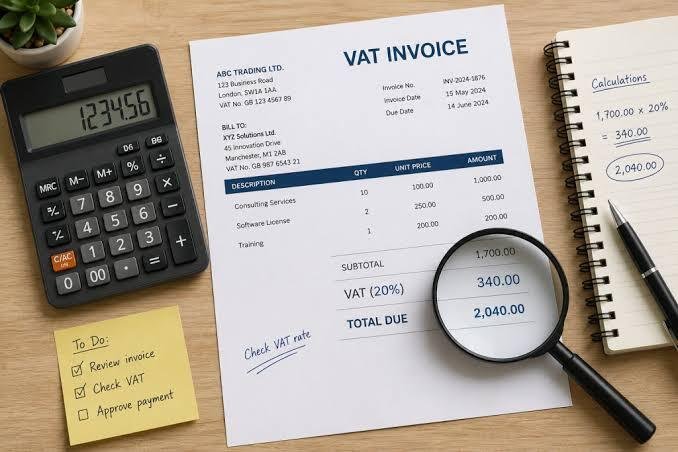
Tracking VAT on business purchases and expenses is an important part of managing a small business in Manchester. Whether you run a consultancy in the city centre, a retail shop in Stockport, a construction business in Salford or an online company serving customers across the UK, accurate VAT records help you understand your costs and prepare reliable tax returns.
For VAT registered businesses, the VAT paid on eligible purchases may be recoverable through a VAT return. However, not every business expense qualifies, and a missing invoice, incorrect VAT amount or personal purchase can lead to an inaccurate claim.
The key is to record each transaction correctly, retain supporting documents and check that the VAT treatment reflects the actual purchase.
This guide explains how small businesses in Manchester should track VAT on purchases and expenses, organise invoices, identify potentially reclaimable VAT, avoid common errors and prepare for their VAT reporting obligations.
What Is VAT on Business Purchases and Expenses?
Value Added Tax, commonly known as VAT, is a tax charged on many goods and services supplied by businesses in the UK.
When a VAT registered business buys eligible goods or services for its business activities, the VAT charged by its supplier may qualify as input tax. Subject to the applicable rules, the business can reclaim eligible input VAT through its VAT return.
VAT charged on the business’s taxable sales is generally known as output VAT. The business calculates the amount payable to HMRC by taking account of output VAT and the input VAT it is entitled to recover, together with any relevant adjustments.
For example, suppose a Manchester business charges £2,000 in output VAT on its sales during a VAT period and has £600 in eligible input VAT on its purchases. If there are no other adjustments, the net VAT payable would be £1,400.
These figures are illustrative. The actual amount depends on the business’s transactions, VAT scheme and applicable rules.
Understanding the difference between VAT on sales and VAT on purchases helps business owners keep clearer records and avoid confusing total expenditure with the amount of VAT that can be reclaimed.
Why Manchester Small Businesses Should Track VAT Carefully
Keeping accurate VAT records is not just an administrative task. It supports cash flow management, helps identify errors and makes it easier to prepare financial reports.
1. Reclaim Eligible VAT
If your business is VAT registered and meets the relevant conditions, you may be able to recover VAT paid on qualifying business purchases.
Examples can include office supplies, business software, equipment, professional services and certain advertising costs.
The exact treatment depends on the type of purchase, its business use, the supplier’s VAT status and the nature of your business activities.
Recording VAT separately helps you identify eligible amounts instead of overlooking them when preparing your return.
2. Avoid Incorrect VAT Claims
Claiming VAT without the appropriate evidence or on an ineligible purchase can create problems if HMRC reviews your records.
A receipt showing that you paid for something does not necessarily prove that the amount includes recoverable VAT. You need to establish what was purchased, whether VAT was charged and whether the claim meets the applicable requirements.
A consistent process helps you identify questionable transactions before submitting your VAT return.
3. Understand Your Business Costs
VAT affects the cost of running a business, but the financial impact differs depending on whether the VAT is recoverable.
For a fully VAT registered business making taxable supplies, eligible input VAT may be reclaimed. For a business that cannot reclaim the VAT, the tax may form part of the overall cost.
Accurate records help you compare supplier prices, calculate project costs and understand how much your business is actually spending.
4. Improve Cash Flow Planning
VAT payments and repayments can affect the amount of cash available to a business.
If you regularly purchase stock, equipment or materials, tracking eligible input VAT can help you estimate the position for your next VAT return.
However, do not assume that every expense will result in a VAT repayment. Your overall position depends on output VAT, eligible input VAT and any adjustments.
5. Prepare for HMRC Checks
HMRC can ask businesses to provide evidence supporting their VAT returns.
Keeping invoices, receipts, bank statements and digital accounting records organised makes it easier to explain the figures reported.
Good record keeping also reduces the amount of time spent searching for missing paperwork when a return is due.
Which Business Purchases and Expenses May Include Reclaimable VAT?
Small businesses often incur a wide range of costs. The first step is to identify the transaction and establish whether VAT was charged.
The following examples illustrate expenses that may qualify for VAT recovery when the relevant conditions are satisfied.
Office Supplies and Equipment
Stationery, printers, office furniture and other business equipment may include VAT.
Keep the supplier invoice and record the purchase under the appropriate category in your accounting software.
For larger purchases, check whether the item is an ordinary expense or a capital asset and whether any special VAT rules apply.
If equipment is also used privately, the business may need to restrict the claim or account for private use under the applicable rules.
Business Software and Subscriptions
Many Manchester businesses pay for accounting software, cloud storage, website hosting, customer relationship management systems and other digital tools.
Keep invoices or subscription statements showing the supplier, amount charged and VAT details where applicable.
Software purchased from an overseas supplier may involve different VAT rules, including the reverse charge in certain circumstances. Do not assume that every digital subscription has UK VAT charged on it.
Marketing and Advertising
Advertising costs can include online advertising, printed promotional materials, website development and marketing agency fees.
Where a supplier charges VAT on an eligible business service, the VAT may be recoverable by a VAT registered business that meets the relevant conditions.
Retain invoices and distinguish actual advertising services from other payments, such as certain platform charges or overseas services that may have different VAT treatment.
Stock, Materials and Packaging
Retailers, ecommerce businesses and manufacturers may purchase goods for resale, raw materials and packaging.
Keep supplier invoices and record purchases against the appropriate inventory or expense category.
If goods are purchased for resale, the bookkeeping should distinguish the purchase of inventory from the eventual cost of goods sold where the accounting method requires it.
Check the VAT shown on each invoice rather than applying a standard assumption to every purchase.
Professional Fees
Accountancy, legal, consultancy and other professional services may include VAT.
Keep invoices that describe the service provided and identify the VAT charged.
If a service relates partly to personal matters or exempt business activities, the amount of VAT recoverable may need to be restricted.
Business Travel and Accommodation
Travel costs require particular care because the VAT treatment depends on the type of expense and the circumstances.
Some qualifying business travel costs may include recoverable VAT. Other expenses have restrictions or special rules.
For example, VAT recovery on passenger car purchases is generally restricted, subject to specific exceptions. Business mileage, fuel, parking and accommodation can also require different treatment depending on the facts.
Retain detailed receipts and discuss unusual travel claims with your accountant rather than assuming every business trip qualifies for full VAT recovery.
Telephone and Internet Costs
Businesses often pay for broadband, mobile phone contracts and communication services.
If a service is used for both business and personal purposes, you may need to apportion the VAT claim according to the relevant rules and evidence.
Keep the bills and document how the business proportion was calculated.
Repairs and Maintenance
Repair costs for business premises, machinery, tools and equipment may include VAT.
Record the supplier invoice and describe the work carried out.
For property improvements or significant building work, the VAT treatment can be more complicated than for routine repairs. Check the nature of the work and the applicable rules before making a claim.
How to Track VAT on Purchases and Expenses Step by Step
A simple, repeatable bookkeeping process helps prevent missing invoices, incorrect VAT codes and duplicated claims.
Step 1: Collect Every Purchase Invoice
Whenever your business buys goods or services, obtain an invoice or other appropriate supporting evidence.
For purchases where you intend to reclaim VAT, make sure the evidence meets the applicable requirements. A valid VAT invoice is particularly important for ordinary VAT recovery claims.
Check the supplier name, invoice date, description of the goods or services, total amount and VAT details where required.
If a supplier has issued an incorrect invoice, ask them to correct it before relying on it to support your claim.
Do not use a pro forma invoice, delivery note or ordinary statement as a substitute for a valid VAT invoice where the rules require one.
HMRC explains the relevant requirements in its official guidance on keeping VAT records.
Step 2: Record the Transaction in Your Accounting Software
Enter each purchase into your accounting system promptly.
Include the transaction date, supplier, expense category, total amount, VAT amount where applicable and payment status.
Use a consistent naming system so that invoices can be found quickly.
For example, a Manchester consultancy might categorise its transactions as office supplies, software subscriptions, advertising, travel and professional fees.
Clear categories make it easier to review spending and prepare financial reports.
Step 3: Check Whether VAT Was Actually Charged
Not every supplier charges VAT, and not every purchase includes the same VAT treatment.
Some suppliers may not be VAT registered. Some goods or services may be zero rated or exempt. Other transactions may involve special arrangements or overseas VAT rules.
Do not calculate a VAT amount from the total price unless you have established that the correct VAT rate applies and the transaction supports that calculation.
Where the invoice does not clearly explain the VAT treatment, ask the supplier for clarification or seek professional advice.
Step 4: Assign the Correct VAT Treatment
Your accounting software may offer VAT codes for standard rated, reduced rated, zero rated, exempt and other transaction types.
Select the code that reflects the actual transaction rather than choosing a code simply because it is commonly used for that expense category.
For example, some items purchased by a business may be standard rated, while others may be zero rated or exempt. A category such as travel can contain transactions with several different VAT treatments.
If a transaction involves overseas services, imports, partial business use or a special VAT scheme, check whether additional rules apply.
Step 5: Separate Business and Personal Spending
Business owners sometimes pay for purchases that contain both business and personal elements.
Only the eligible business proportion may be recoverable in relevant cases, and some expenses are subject to specific restrictions.
Suppose the VAT on a mobile phone bill is £40 and reliable records show that 75% of the use relates to the business. If the applicable rules allow apportionment on that basis, the business proportion would be £30.
This is an illustrative calculation, not a universal rule for mobile phone expenses. The method must be appropriate for the actual arrangement and supported by evidence.
Keep personal purchases out of business expense claims unless a legitimate business element can be identified and the applicable rules permit the treatment.
Step 6: Reconcile Invoices With Bank Transactions
Compare recorded purchases with your business bank statement, payment card statement or cash records.
This helps identify missing invoices, duplicated expenses and payments that have been assigned to the wrong supplier.
Remember that the payment date and invoice date may differ. The appropriate VAT accounting treatment depends on the applicable scheme and transaction circumstances.
If a payment covers several invoices, retain the breakdown showing how the total was allocated.
Step 7: Review VAT Before Submitting the Return
Before submitting your VAT return, review the purchase transactions included in the reporting period.
Check that:
- Relevant purchase invoices have been retained.
- VAT amounts agree with the supporting documents.
- The correct VAT codes have been applied.
- Personal expenditure has not been claimed incorrectly.
- Duplicate transactions have been removed.
- Refunds, credit notes and adjustments have been accounted for.
- Transactions involving overseas suppliers have received appropriate attention.
- Any restricted or partially recoverable VAT has been treated correctly.
This review helps catch errors before the figures are submitted to HMRC.
Practical Example: Tracking VAT on Business Expenses
Consider a small Manchester business that is VAT registered and makes taxable supplies. During a VAT period, it purchases office supplies, software and marketing services.
The following figures are illustrative and assume the amounts shown are eligible for VAT recovery, supported by appropriate invoices and subject to no restrictions.
| Purchase | Net amount | VAT at 20% | Total paid |
| Office supplies | £200 | £40 | £240 |
| Business software | £100 | £20 | £120 |
| Marketing services | £300 | £60 | £360 |
| Total | £600 | £120 | £720 |
| The business has spent £720 in total and paid £120 in VAT. | |||
| If all three purchases meet the relevant conditions, the business may include £120 of input VAT in its VAT return. | |||
| Now suppose the business has £900 in output VAT from its sales during the same period. If there are no other transactions or adjustments, the illustrative net VAT payable would be £780. | |||
| The business should retain the invoices, record the transactions correctly and ensure that the figures agree with the supporting evidence. | |||
| If one supplier was not VAT registered, or one service was subject to a different VAT treatment, the calculation would need to change. |
Common VAT Tracking Mistakes Small Businesses Should Avoid
Claiming VAT Without a Valid Invoice
A bank statement proves that money was paid, but it may not contain enough information to support a VAT claim.
Where a valid VAT invoice is required, retain it and check that the information is correct.
If the invoice is missing or incorrect, contact the supplier to obtain suitable evidence.
Assuming Every Business Expense Includes VAT
Some expenses do not include VAT, while others may be exempt or zero rated.
Never assume that every purchase contains VAT at the standard rate.
Record the actual treatment supported by the invoice and applicable rules.
Claiming VAT on Personal Purchases
An expense is not automatically eligible for VAT recovery simply because the business owner paid for it.
Private expenditure is generally not recoverable as input VAT. Mixed use expenses may require an appropriate apportionment.
Keep a clear distinction between personal and business transactions.
Using the Wrong VAT Code
Incorrect VAT codes can affect the figures reported on a return.
For example, treating an exempt purchase as standard rated could result in an incorrect claim.
Review transactions carefully and seek advice when a purchase does not fit a familiar category.
Forgetting Credit Notes and Refunds
When goods are returned or a supplier issues a credit note, the original VAT position may need to be adjusted.
Retain the credit note, connect it with the original purchase and record the adjustment correctly.
This prevents the business from claiming VAT that is no longer recoverable.
Leaving Bookkeeping Until the VAT Deadline
Waiting until a return is due makes it harder to find missing documents and investigate unusual transactions.
Record purchases regularly and review the VAT position throughout the period.
A weekly or monthly bookkeeping routine is often easier to manage than processing several months of paperwork at once.
Can You Reclaim VAT on Expenses Incurred Before VAT Registration?
In some circumstances, a business can reclaim VAT paid on eligible purchases made before it registered for VAT.
HMRC generally permits claims for qualifying goods purchased within four years before registration, subject to conditions, and for qualifying services purchased within six months before registration.
For goods, the business must still hold the goods or have used them to make other goods it still holds at the time of registration. The purchases must also relate to the business and meet the applicable conditions.
For services, the costs must meet the relevant business purpose requirements.
These rules are not permission to reclaim VAT on every historic expense. Personal purchases, ineligible expenditure and transactions that fail the conditions cannot automatically be included.
Review older invoices carefully and retain the evidence showing when the purchase was made and how it relates to your business.
Read HMRC’s guidance on reclaiming VAT on business expenses before including pre registration purchases in a return.
What Expenses Cannot Normally Be Claimed for VAT?
Some purchases do not qualify for VAT recovery, even where a business is VAT registered.
Examples include purchases used entirely for personal purposes and certain business entertainment costs. Other expenses may be restricted by specific rules or require an apportionment.
Personal Expenditure
VAT on items purchased entirely for personal use cannot generally be reclaimed as input VAT.
If an item has both business and private use, check whether a reasonable and permitted apportionment is appropriate.
Business Entertainment
VAT on business entertainment is generally blocked, subject to specific exceptions. The rules can differ for certain staff related expenses and other circumstances.
Do not assume that a restaurant bill, hospitality event or client entertainment expense qualifies simply because it was incurred while conducting business.
Passenger Cars
VAT recovery on cars is subject to significant restrictions. In many cases, VAT on purchasing a car cannot be reclaimed unless a specific exception applies.
The treatment of commercial vehicles, running costs and fuel can differ. Check the actual vehicle and usage arrangements before making a claim.
Purchases Relating to Exempt Supplies
If your business makes exempt supplies, VAT on associated purchases may be irrecoverable or subject to partial exemption calculations.
Businesses with both taxable and exempt activities may need to allocate their input VAT between the different activities.
These examples are not an exhaustive list. Review the applicable rules for unusual or high value purchases before including them in a VAT return.
How Accounting Software Can Help Track VAT
Accounting software can make it easier to record purchases, store invoices and prepare VAT reports.
Many systems allow businesses to connect bank accounts, upload receipts and assign VAT codes to transactions.
However, software cannot automatically determine the correct VAT treatment in every situation. The quality of the output depends on the information entered and the settings used.
Use Digital Invoice Storage
Save invoices electronically in a structured folder or accounting system.
A useful file naming format includes the supplier, invoice date and invoice number. This makes it easier to locate evidence when reviewing a transaction.
Automate Routine Data Entry Carefully
Bank feeds and invoice capture tools can reduce manual work.
Review imported transactions to confirm that the supplier, amount, date and VAT code are correct. A bank feed alone may not provide sufficient evidence to support a VAT claim.
Review VAT Reports Regularly
Run a VAT report before submitting your return and investigate unusual balances or transactions.
Check whether the report includes transactions that should be excluded, duplicated purchases or incorrect tax codes.
If you change software or connect a new bank account, review the first reporting period carefully to confirm that transactions are being captured correctly.
Making Tax Digital and VAT Record Keeping
Making Tax Digital for VAT requires most VAT registered businesses to maintain relevant digital records and submit VAT returns using compatible software, unless an exemption applies.
Digital records generally need to include details of sales and purchases, including the time and value of supplies and the relevant VAT information. Businesses must also keep records of applicable adjustments and other required details.
The rules can affect how a business moves information between spreadsheets, accounting software and VAT submission systems.
For example, a business that records purchases in one system and prepares its VAT return in another should check that its process meets the applicable digital record keeping and digital linking requirements.
Paper invoices may still be received, but the relevant VAT information generally needs to be recorded digitally where the rules require it.
Read HMRC’s official guidance on keeping VAT records to understand the requirements relevant to your business.
How Often Should Manchester Businesses Review VAT on Expenses?
The right frequency depends on how many transactions your business processes and how often you submit VAT returns.
A practical routine could include:
Weekly: Collect new invoices, upload receipts and record purchases while the details are easy to verify.
Monthly: Reconcile bank transactions, review expense categories and investigate missing invoices or unusual VAT amounts.
Before each VAT return: Check the VAT report, confirm the supporting evidence and review adjustments.
At year end: Check outstanding invoices, credit notes and unresolved transactions with your accountant as part of the wider accounts process.
Businesses with high transaction volumes may need more frequent reviews. The purpose is to maintain reliable records continuously instead of trying to reconstruct the entire period at the deadline.
Why Professional VAT Support Can Help Small Businesses in Manchester
VAT rules can become complicated when a business has mixed personal and business expenditure, overseas suppliers, exempt activities, significant equipment purchases or transactions made before registration.
Professional bookkeeping and accounting support can help identify errors, organise invoices and establish a repeatable process for VAT reporting.
Accountancy Net provides accounting, bookkeeping and VAT related services for entrepreneurs, startups and established businesses. Its approach includes data capture, bookkeeping, VAT calculation and filing, and year end procedures.
You can learn more through the Accountancy Net company profile, which explains the practice’s experience supporting businesses, including ecommerce companies.
Professional support may be particularly useful if:
- You are unsure which expenses qualify for VAT recovery.
- Your invoices do not show the expected VAT amounts.
- You have transactions involving overseas suppliers.
- Your business makes both taxable and exempt supplies.
- You have missed invoices or made errors in earlier returns.
- You want to improve the accuracy of your accounting software.
- You need help reviewing VAT records before submission.
If you need assistance with your business accounts, visit the Accountancy Net website to explore its services.
You can also contact the practice through its contact page or use this Google Maps search for Accountancy Net in Manchester. This is a Google Maps search link rather than a verified direct Google Business Profile URL.
VAT Tracking Checklist for Small Businesses
Use this checklist to review your purchase and expense records:
- Collect invoices and receipts for business purchases.
- Check whether the supplier charged VAT.
- Confirm that invoices contain the necessary information.
- Record each purchase in the appropriate expense category.
- Apply the correct VAT code.
- Separate personal and business expenditure.
- Check whether any purchase has restricted VAT recovery.
- Record supplier refunds and credit notes.
- Reconcile purchase records with bank transactions.
- Retain evidence supporting VAT claims.
- Review VAT reports before submitting returns.
- Keep digital records in accordance with applicable requirements.
- Investigate unusual transactions and missing invoices.
- Seek professional advice where the correct treatment is unclear.
Following the same process each period helps make VAT reporting more consistent and reduces the risk of avoidable errors.
Frequently Asked Questions
Can a small business in Manchester reclaim VAT on business expenses?
A VAT registered business can generally reclaim eligible VAT on purchases used for its taxable business activities, subject to the relevant rules and supporting evidence. Personal expenditure, certain restricted expenses and purchases relating to exempt supplies may not qualify for full recovery.
Do I need a VAT invoice to reclaim VAT?
A valid VAT invoice is normally required to support a VAT recovery claim on standard business purchases. An ordinary statement, delivery note or pro forma invoice is not a substitute where a valid VAT invoice is required.
Can I reclaim VAT on office supplies and software?
VAT on office supplies and software may be recoverable when the purchases qualify, the business is entitled to reclaim the VAT and appropriate evidence is retained. Check the supplier’s invoice and the nature of the service before making a claim.
Can I reclaim VAT on business expenses paid before registration?
In certain circumstances, qualifying goods purchased within four years and qualifying services purchased within six months before VAT registration may be eligible. Specific conditions apply, so check HMRC guidance before including these purchases in your return.
Can I reclaim VAT on expenses that are partly personal?
Where a purchase has both business and personal use, the recoverable amount may need to be restricted to the eligible business proportion. The calculation should follow the applicable rules and be supported by appropriate evidence.
Can I reclaim VAT if my business is not VAT registered?
A business that is not VAT registered generally cannot reclaim input VAT through a VAT return. If you are considering voluntary registration, assess the financial and administrative implications before deciding.
How should I record VAT on supplier refunds?
Keep the supplier’s credit note or other appropriate supporting document, link it to the original purchase and record the adjustment using the correct VAT treatment. This helps ensure that your VAT recovery remains accurate.
What happens if I claim VAT incorrectly?
An incorrect VAT claim may need to be corrected, and additional tax, interest or penalties may apply depending on the circumstances. Review the issue promptly and follow HMRC’s procedures for correcting errors.
How long should I keep VAT invoices and records?
VAT records generally need to be kept for at least six years, although particular records and circumstances can have different requirements. Check HMRC’s current guidance for the retention period relevant to your business.
How often should I update my VAT records?
Record purchases regularly, review transactions at least monthly where practical and check your VAT figures before submitting each return. Businesses with many transactions may benefit from more frequent bookkeeping.
Final Thoughts: Keep Your Business VAT Records Accurate
Tracking VAT on purchases and expenses helps small businesses in Manchester maintain reliable financial records, identify eligible VAT recovery and prepare accurate returns.
The process begins with collecting the right invoices, recording transactions correctly and checking the VAT treatment of each purchase. Regular reconciliation and review can help prevent missing documents, duplicated entries and unsupported claims.
Do not assume that every business expense includes recoverable VAT. Check the evidence, consider the purpose of the purchase and apply the rules that match your circumstances.
If your business has complex expenses, overseas transactions or uncertainty about previous VAT claims, professional advice can help you establish a more reliable process.
Need help managing VAT for your Manchester business? Contact Accountancy Net to discuss your bookkeeping and VAT requirements and find out how its accounting services may support your business.